
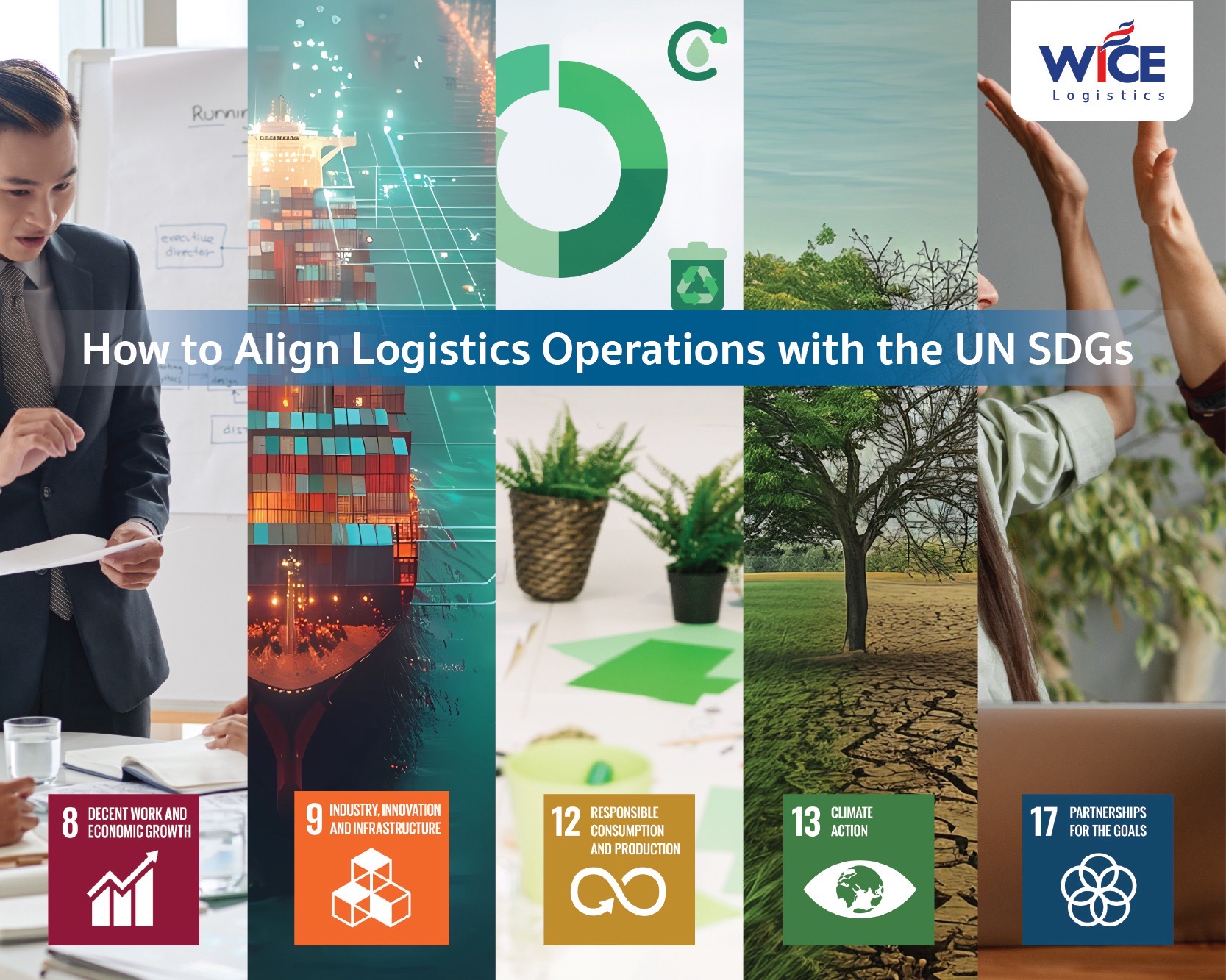
The United Nations Sustainable Development Goals (UN SDGs), adopted by 193 countries in 2015, outline 17 global objectives to be achieved by 2030. These goals target critical areas such as climate action, poverty reduction, quality education, gender equality, and sustainable industry. For the logistics sector – central to global trade and supply chains – aligning operations with the SDGs is not only a moral responsibility but also a strategic opportunity to lead sustainable transformation. Because logistics activities are closely tied to emissions, labor practices, infrastructure, and procurement, companies in this space are uniquely positioned to support several of the SDGs through transparent supply chains, low-carbon innovations, and ethical sourcing.
One of the most directly relevant goals is SDG 13: Climate Action, specifically Target 13.2, which calls for integrating climate measures into business strategies and policies. Logistics companies can respond by decarbonizing their fleets through the adoption of electric vehicles, alternative fuels, and intelligent route optimization systems. A leading example is Maersk, which has committed to achieving net-zero shipping emissions by 2040 using green methanol-powered vessels (Maersk, 2022).
Closely tied to this is SDG 9: Industry, Innovation and Infrastructure, and particularly Target 9.4, which focuses on upgrading infrastructure to support clean and sustainable technologies. Investments in smart warehouses, IoT-driven asset tracking, and automation not only boost operational efficiency but also reduce the sector’s overall environmental footprint (World Economic Forum, 2021).
Meanwhile, SDG 12: Responsible Consumption and Production urges companies to substantially reduce waste, as emphasized in Target 12.5. Logistics providers can address this by implementing reusable packaging, optimizing reverse logistics systems, and conducting lifecycle assessments to track and minimize environmental impacts.
The social dimension is addressed through SDG 8: Decent Work and Economic Growth, especially Target 8.8, which promotes the protection of labor rights and safe working conditions. This can be achieved by enforcing supplier codes of conduct, conducting third-party labor audits, and investing in employee development – particularly in green logistics competencies.
Finally, SDG 17: Partnerships for the Goals, and its Target 17.16, highlights the importance of strengthening collaborations between public and private sectors. Logistics companies can contribute by partnering through global platforms such as the Smart Freight Centre and the Science Based Targets initiative (SBTi), or by participating in national carbon reduction programs.
A compelling case in point is DHL Group, whose “GoGreen” program is fully aligned with several SDGs. The company has committed to carbon-neutral shipping and green warehousing while setting science-based emissions targets. DHL aims to reduce its overall emissions to below 29 million tonnes of CO₂e by 2030, demonstrating how global logistics leaders can convert sustainability pledges into measurable outcomes (Deutsche Post DHL Group, 2023).
Aligning logistics operations with the UN SDGs is far more than a compliance exercise – It is a pathway to innovation, resilience, and global leadership. By embedding SDG principles into every aspect of the supply chain, from emissions and energy use to labor practices and partnerships, logistics companies can translate global sustainability goals into tangible local impacts. The result is a future-ready, ethically responsible business that contributes meaningfully to global progress while creating long-term value for stakeholders.