
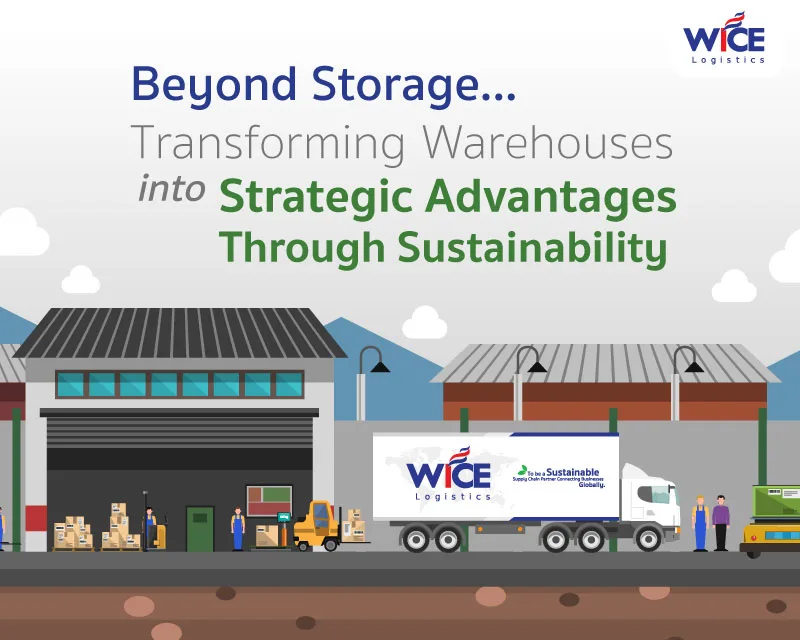
In today’s logistics landscape, the role of warehouses has evolved beyond being simple operational spaces. They have become strategic assets that play a critical role in shaping an organization’s resilience and long-term competitiveness.
Traditionally, warehouse management has focused on capacity, speed of distribution, and cost control. While these factors remain essential, they are no longer sufficient in an environment where supply chains face increasing volatility from rising energy costs, climate-related risks, and more stringent regulatory requirements. As a result, the key question for business leaders today is no longer just how efficiently a warehouse is managed, but whether it is being leveraged to strengthen long-term business resilience.
At the core of this transformation lies sustainability, not as an additional cost, but as a strategic enabler of stability and growth.
Sustainability investments are often perceived as additional expenses. However, for leading organizations, they represent a strategic investment in efficiency and risk management. When sustainability is integrated into core business strategy, it enables organizations to reduce operating costs, optimize resource utilization, and build stronger trust with business partners.
This perspective is reflected in the actions of global industry leaders. DHL continues to advance its Mission 2050 strategy by investing in low-carbon warehouses and energy-efficient technologies to achieve net-zero emissions. Amazon has enhanced its fulfillment centers by integrating renewable energy with advanced automation under The Climate Pledge, improving both operational performance and environmental outcomes. At the same time, Prologis, a global leader in real estate logistics, has demonstrated through its Sustainability Report that warehouses equipped with solar energy systems and smart infrastructure can deliver measurable long-term cost savings while increasing asset value.
Energy remains a key variable in warehouse management. According to the International Energy Agency, improving energy efficiency is critical to reducing both environmental impact and operational costs. Upgrading infrastructure through LED lighting, intelligent temperature control systems, and renewable energy adoption helps create cost stability in the face of global energy price fluctuations.
In addition, climate resilience has become a necessary consideration. Warehouses designed to withstand environmental risks such as flooding and extreme weather are better positioned to maintain business continuity during disruptions. Organizations that proactively align with increasingly stringent environmental standards can turn regulatory pressure into an opportunity to strengthen customer trust, particularly among stakeholders who prioritize carbon transparency and responsible operations.
The warehouse of the future is not defined by a single initiative, but by the integration of operations, technology, and people. Advanced warehouse management systems provide real-time visibility and operational efficiency, while a culture of sustainability ensures that improvements are embedded across all levels of the organization.
At WICE Logistics, warehouses are viewed as fundamental pillars of a sustainable supply chain. By integrating environmental considerations into operations, leveraging innovation, and supporting partners in achieving their ESG objectives, WICE is committed to delivering long-term value. The future of logistics is not only about moving goods, but about doing so in a responsible and sustainable manner.
The role of the warehouse is undergoing a fundamental transformation. It is no longer just about managing operations efficiently, but about building a strong foundation for long-term success.
Business leaders must consider whether they are focused on short-term cost management or investing in resilience and long-term competitiveness. Warehouses that succeed in the future will be those designed with sustainability in mind and built to adapt to change.
The organizations behind them will not simply respond to disruption. They will lead it by using sustainability as a strategic tool to shape the future of the industry.
References
- DHL Group. (2023). Mission 2050: Zero emissions. Retrieved from https://www.dhl.com/global-en/home/about-us/sustainability.html
- Amazon. (2023). The Climate Pledge and Amazon sustainability initiatives. Retrieved from https://www.aboutamazon.com/planet/climate-pledge
- Prologis. (2023). Sustainability report 2023. Retrieved from https://www.prologis.com/sustainability/esg-report
- International Energy Agency (IEA). (2022). Energy efficiency 2022. Paris: IEA. Retrieved from https://www.iea.org/reports/energy-efficiency-2022
- McKinsey & Company. (2020). Climate risk and response: Physical hazards and socioeconomic impacts. Retrieved from https://www.mckinsey.com/capabilities/sustainability/our-insights/climate-risk-and-response-physical-hazards-and-socioeconomic-impacts
- World Economic Forum. (2023). Net-zero challenge: The supply chain opportunity. Retrieved from https://www.weforum.org/reports/net-zero-challenge-the-supply-chain-opportunity/